

Some evenings end with applause. Others end with people searching for words.
On the evening of June 30, 2026, at the historic Gaiety Theatre, the audience walked out carrying something heavier than entertainment. Faces were quiet. Conversations came slowly. More than a few people wiped their eyes before stepping into the cool Shimla air. It was not because they had witnessed tragedy. They had witnessed recognition.
Written and directed by Shoryaveer Sagar and produced by Shoryagate, “Baap” arrived with a deceptively simple title- The Father.
The word itself is ordinary. The play refused to treat it that way.
Instead, it asked a painful question. How much of a father’s love do we understand while he is still alive?

For nearly ninety minutes, “Baap” moved like a psychological thriller before quietly revealing itself as something entirely different. It was never interested in solving a kidnapping. It was interested in exposing the emotional crimes children unknowingly commit against their parents, the gratitude left unsaid, the affection postponed until time has already closed the door.
I watched the performance with my own parents, almost by accident. It was the first time the three of us had sat together in a theatre. I did not know then how much that coincidence would shape the evening. Certain moments on stage seemed less like fiction and more like conversations borrowed from families across the country, including my own.
The play opens in darkness.
Midnight.
A basement has been converted into an investigation room. Police equipment covers the tables. Recording devices wait silently. Every ring of the telephone carries the possibility of hope or catastrophe.
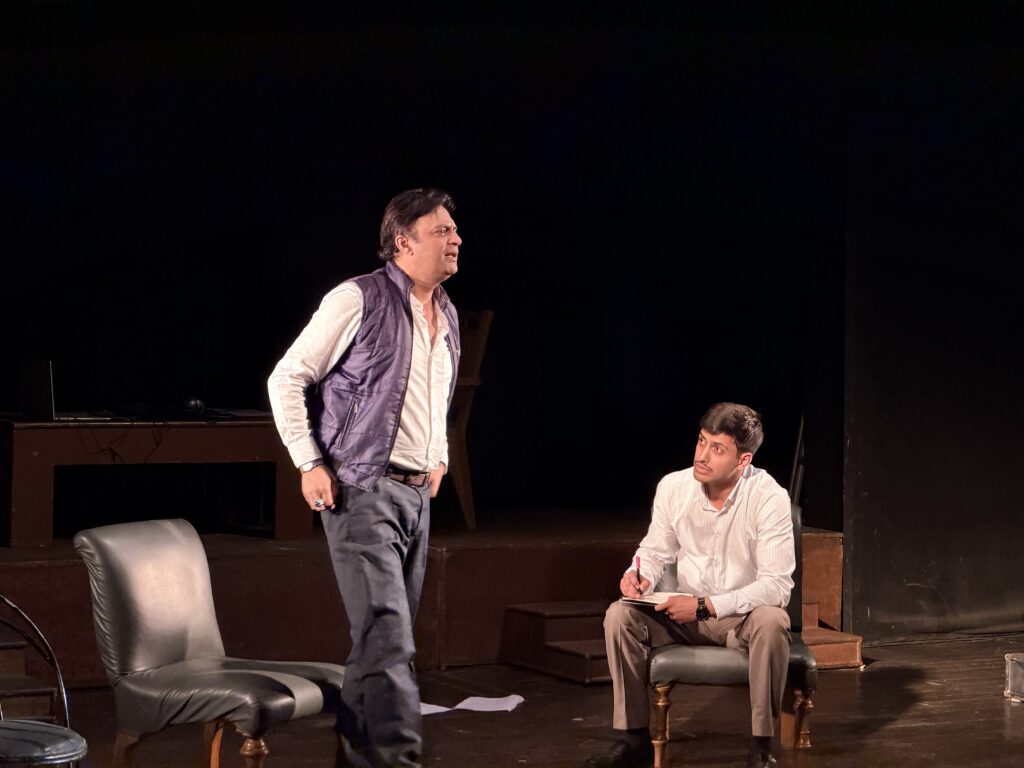
Akshu, played by Shoryaveer Sagar himself, is a police officer whose young son has been kidnapped. His professional discipline demands secrecy. The public must not know. The media must remain outside. The investigation begins from within his own house.
An investigating officer, played with measured restraint by Rajat Thakur, establishes a surveillance and call recording system. Every incoming conversation is monitored. Every lead matters.
The tension is immediate. Then something unexpected happens.
Akshu reaches for alcohol.
Each drink dissolves the wall between the present and memory. Instead of discussing strategy, he begins speaking to his late father.

The first surprise of “Baap” lies here. Most thrillers use alcohol to reveal weakness. Here it becomes a doorway into grief. The missing child remains the immediate crisis, yet the absent father quietly becomes the emotional center of the story.
It is a risky dramatic choice. It works because Sagar never allows sentimentality to replace authenticity.
His Akshu is neither heroic nor broken. He is simply a son who never stopped missing his father.

The ransom call finally arrives. Thirty lakh rupees.
The investigation team traces the number with professional urgency, only to discover that every trail leads nowhere. Fake identities. False addresses. Dead ends.
The pressure intensifies.
Then the play deliberately interrupts its own momentum.
Akshu’s friend enters.
Played by Kawar Ravindra, he is an artist, philosopher, and perhaps the only character comfortable asking uncomfortable questions. Akshu dislikes him for deeply personal reasons. The philosopher appears emotionally close to Akshu’s wife, creating a tension that never needs exaggerated dialogue.
Their arguments become one of the production’s strongest devices.

One man believes in logic. The other believes in emotion.
One speaks as a policeman. The other speaks as someone who studies human beings instead of evidence.
Neither fully understands the other. At least not yet.

Before this conflict settles, another interruption arrives.
The household helper, portrayed with quiet assurance by Ritu Raghuvanshi, informs Akshu that a man has been arrested after attempting to damage his car during a minor incident the previous evening.
The man, played by Neeraj Raghuvanshi, appears frightened rather than dangerous.
He is a migrant worker. He has three children.
Akshu’s rage initially knows no restraint. He humiliates the man, interrogates him harshly, even orders him to clean the damaged vehicle.

Then one sentence changes everything.
Three children.
The father inside Akshu defeats the policeman.
His anger disappears almost instantly. Instead of punishment, he offers opportunity. He promises to speak with a friend who owns a liquor store so the struggling worker might establish a small egg stall nearby and rebuild his life honestly.
It is one of several moments where the play reminds us that justice without compassion is incomplete.
Outside, reporters gather.
Inside, another note from the kidnapper appears. The investigation accelerates. Police pursue fresh clues.
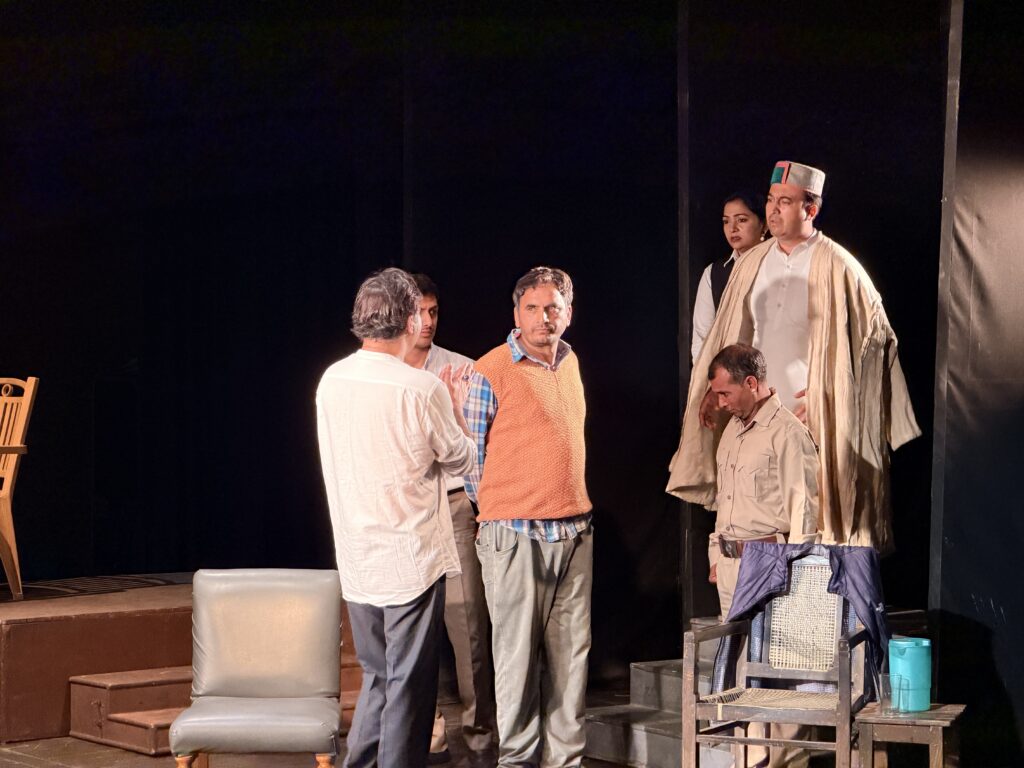
Eventually they capture the kidnapper, portrayed with remarkable emotional restraint by Dheeraj Raghuvanshi.
Akshu asks only one question.
“Is my son alive?”
The answer comes.
Yes.
Everything changes.
The remaining officers rush to rescue the child while Akshu stays behind with the kidnapper.
The interrogation becomes brutal.
It is physically violent, emotionally exhausting, and impossible to dismiss as spectacle because every blow carries the weight of a father’s terror.
Finally the kidnapper speaks. His confession transforms the entire narrative. His own father is dying from terminal cancer. He has exhausted every legitimate option. Treatment costs money he does not possess. He knows the illness will eventually win anyway. Still, he cannot bear watching his father die without trying.

Then he noticed a well-dressed schoolboy returning home. An expensive uniform suggested wealth. Desperation replaced morality. He committed the kidnapping.
The brilliance of this sequence lies in its refusal to simplify guilt. The audience does not excuse the crime. Neither do they completely reject the criminal.
Earlier, Akshu had been prepared to pay far more than the demanded ransom to save his son. Now he confronts another son willing to sacrifice everything, including his own future, to save his father.

One father waits to be rescued.
Another waits to die.
Two sons.
Two impossible choices.
Few productions manage to hold moral complexity without collapsing into melodrama.
“Baap” remains balanced because it never argues who deserves greater sympathy. It asks viewers to hold both griefs at once.
News arrives.
Akshu’s son has been found alive.
Safe.
Healthy.
Relief floods the stage.
Then comes perhaps the play’s quietest act of courage. Akshu retrieves the ransom money. He hands every rupee to the kidnapper. Not as payment. As mercy.
He tells him to leave and spend it on his father’s treatment.
The kidnapper collapses emotionally. He offers lifelong servitude in return.
Akshu refuses.
He asks only one thing.
Go.
At this point I believed the play had reached its conclusion.
It felt complete.
The emotional arc seemed resolved. The audience had already traveled through fear, anger, forgiveness, and compassion. Ending there would have satisfied almost every conventional dramatic structure.
Instead, “Baap” revealed its true destination. Akshu’s rescued son finally returns home. Unexpectedly, Akshu does not rush toward him. He asks the house helper to send the child to his mother’s room.
His relief exists.
His love exists.
So does his inability to immediately express it. Every parent understands this contradiction. Love and anger often arrive together.
The investigating officer questions why the kidnapper was released. Akshu silences him. The official version presented to the press is simple. The kidnapper learned he had abducted a policeman’s son and released the child without accepting ransom.
Truth becomes another sacrifice.
One by one, everyone leaves.
Only Akshu and the philosopher remain.
Then comes the scene no audience member anticipates. The philosopher quietly tells Akshu that he speaks with his father. Akshu dismisses him. Until the philosopher repeats private exchanges known only to Akshu and his late father.
Disbelief turns into fear.
Fear becomes hope.
Hope becomes surrender.
The lighting shifts into deep blue.
The stage grows still.
Then a father’s voice fills the theatre.
It does not matter whether the audience interprets the moment as supernatural, symbolic, psychological, or theatrical imagination. What matters is what follows.
Akshu breaks.
He embraces his friend as though embracing the father he has missed every day. Words emerge that neither father nor son managed to speak during life.
Love.
Regret.
Pride.
Forgiveness.

The conversation countless families postpone until it is too late finally takes place. No elaborate scenery was needed. No visual spectacle attempted to distract from the performance.
Only voices.
Silence.
Memory.
That simplicity gave the climax extraordinary force.
When the lights faded, the applause arrived almost reluctantly.
It was loud.
It lasted.
Yet even applause seemed insufficient.
Shoryaveer Sagar carried the demanding central role for the full ninety minutes while also presenting a script that shifted between suspense, philosophy, humour, and emotional confession without losing structural control. His writing displayed unusual confidence in restraint. Instead of instructing the audience when to cry, he trusted them to arrive there on their own.
The supporting ensemble strengthened every transition. Rajat Thakur grounded the investigation with disciplined realism. Kawar Ravindra provided the intellectual and emotional counterweight essential to the story’s final revelation. Ritu Raghuvanshi offered warmth and humanity in scenes that easily could have served merely as narrative bridges. Neeraj Raghuvanshi and Dheeraj Raghuvanshi represented two different faces of desperation, one ordinary and one criminal, yet both rooted in family.
Behind the scenes, Ashok Narwal’s lighting design became an invisible storyteller, particularly during the final blue-lit encounter between father and son. Rohit Kanwal’s sound design supported the emotional rhythm without overwhelming it. Divya Sagar’s contribution to the additional cast completed an ensemble that understood the value of collective performance over individual display.
Long after the curtain call, one thought remained.
Many plays tell audiences to love their parents.
“Baap” does something far more unsettling.
It reminds us that fathers often spend decades speaking through actions while families wait for words.
By the time those words finally arrive, they are sometimes heard only in memory.
That is why “Baap” lingered.
Not because it presented an unforgettable kidnapping.
Because it reminded every son and daughter in the theatre that somewhere, perhaps in the next room, perhaps only in memory, there is a father who has spent a lifetime loving without asking for applause.